
Prolapsed 3rd Eye - Post Surgery
Forum rules
The rules for this forum are different from all the others on this site.
1) Questions regarding sick skinks do not belong here.
2) If you are not sure if your topic is OK here, post it in the General Discussion forum; a moderator can then move it here if appropriate.
3) This forum is for advanced discussions, such as scientific, medical, reproductive, pathological, environmental, etc.
4) PROOF, FACT, and BACK IT UP are three things to keep in mind when posting.
5) Comments need to add to the discussion. “Good job”, “I agree”, or “Nice skink” etc, do not add to the discussion and are not allowed here. If stating an opinion, back it up with what experiences have led to that opinion.
6) The 3 month rule is not in effect; you may post on any thread no matter how old it is.
The rules for this forum are different from all the others on this site.
1) Questions regarding sick skinks do not belong here.
2) If you are not sure if your topic is OK here, post it in the General Discussion forum; a moderator can then move it here if appropriate.
3) This forum is for advanced discussions, such as scientific, medical, reproductive, pathological, environmental, etc.
4) PROOF, FACT, and BACK IT UP are three things to keep in mind when posting.
5) Comments need to add to the discussion. “Good job”, “I agree”, or “Nice skink” etc, do not add to the discussion and are not allowed here. If stating an opinion, back it up with what experiences have led to that opinion.
6) The 3 month rule is not in effect; you may post on any thread no matter how old it is.
-
Scooter_in_Kindergarten
- Bluey Beginner

- Posts: 152
- Joined: Wed Jul 27, 2011 7:25 pm
- Country:
- Location: Central Florida
Re: Prolapsed 3rd Eye - Post Surgery
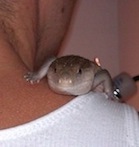
ps. sorry this is a bad pic. my arm/sweater was blocking him from scooting away from the camera.
-
Karen
- Bluey Addict

- Posts: 477
- Joined: Tue Aug 16, 2011 7:41 pm
- Country: USA
Re: Prolapsed 3rd Eye - Post Surgery
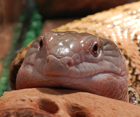
Wow that does look a lot better. I'm sure Scooter is happy that things can get back to normal. Did the vet see anything during the surgery that might have caused all this? I remember you mentioning that the vet said it was likely because of trauma to the eye, can you see any injuries to the eye itself now that it is visible again?
• 0.1.0 Merauke - Sylvia
• 0.0.1 Northern - Tiberi
• 0.0.1 Northern - Tiberi
-
Scooter_in_Kindergarten
- Bluey Beginner
- Posts: 152
- Joined: Wed Jul 27, 2011 7:25 pm
- Country:
- Location: Central Florida
Re: Prolapsed 3rd Eye - Post Surgery
Karen: No, the vet was very puzzled as to what might have caused this. He said he has seen this before in Monitors and other lizards but in each case it was very clear that there was trauma to the eye. In this case there was no visible trauma or injury. He guessed that 'maybe' his substrate got lodged in his eye or he might have scratched it while roaming my classroom. We don't know. What caused this 
-
xxmonitorlizardxx
- Walks with Squirrels
- Posts: 4050
- Joined: Mon Apr 26, 2010 7:06 pm
- Your Facebook name: Jeremy Johnson
- Country:
- Location: NJ, USA
Re: Prolapsed 3rd Eye - Post Surgery
I'm not sure if it's just me, but I think I still see part of the Nictitating membrane in the last pic.
-
ssr
- Bluey Addict
- Posts: 964
- Joined: Mon Mar 03, 2008 5:34 pm
- Country:
- Location: Iowa
Re: Prolapsed 3rd Eye - Post Surgery
He's looking good. Thanks for taking such great care of him.
-
El Lobo
- The Blotched Brigade

- Posts: 3405
- Joined: Sat Dec 06, 2008 5:49 pm
- Country:
- Location: Blue Mountains Australia
Re: Prolapsed 3rd Eye - Post Surgery
I hope Scooter is well on the way to recovery.
An extract from a paper presented to a veterinary conference earlier this year may be of interest.
Diseases of the Lacrimal System and Third Eyelid. What Every Clinician Must Know About Diagnosis & Therapy
Ron Ofri, DVM, PhD, DECVO
Koret School of Veterinary Medicine, Hebrew University of Jerusalem, Rehovot, Israel
Third Eyelid Disorders
Prolapse or protrusion of the third eyelid is a common presentation. Bilateral protrusion is usually caused by decreased orbital mass (e.g., dehydration or cachexia) causing enophthalmos. It may also be observed in cats with Haw's syndrome, or cases of extraocular polymyositis. Unilateral protrusion is commonly seen due to space occupying retrobulbar diseases that are pressuring the third eyelid (e.g., retrobulbar abscess or tumor). Pain, causing globe retraction, and sympathetic denervation (Horner's syndrome) will likewise cause unilateral protrusion.
The third eyelid may also be visibly prominent in cases of conjunctivitis. Though the bulbar and palpebral conjunctiva are usually also affected, clinicians should remember the presence of lymphatic follicles on the inner surface of the third eyelid. These may hypertrophy during inflammation, and may need to be debrided following its resolution.
Another common problem is "cherry eye", or prolapse of the tear gland located at the base of the third eyelid. This is probably caused by weakness in the attachments to the periorbita, and some dog breeds may be genetically predisposed. Prolapsed glands should be replaced surgically, most commonly by various pocketing techniques or anchoring to the periosteum of the ventral orbit. Excision of the gland, which makes a significant contribution to overall tear production, predisposes the dog to KCS. It should be avoided at all costs, and indeed it is contraindicated except in cases of third eyelid neoplasia or severe trauma.
Scrolling of the third eyelid is another disorder with genetic predisposition that can only be repaired surgically. And finally, clinicians presented with a painful eye should always remember the possibility of foreign bodies "hiding" behind the third eyelid.
An extract from a paper presented to a veterinary conference earlier this year may be of interest.
Diseases of the Lacrimal System and Third Eyelid. What Every Clinician Must Know About Diagnosis & Therapy
Ron Ofri, DVM, PhD, DECVO
Koret School of Veterinary Medicine, Hebrew University of Jerusalem, Rehovot, Israel
Third Eyelid Disorders
Prolapse or protrusion of the third eyelid is a common presentation. Bilateral protrusion is usually caused by decreased orbital mass (e.g., dehydration or cachexia) causing enophthalmos. It may also be observed in cats with Haw's syndrome, or cases of extraocular polymyositis. Unilateral protrusion is commonly seen due to space occupying retrobulbar diseases that are pressuring the third eyelid (e.g., retrobulbar abscess or tumor). Pain, causing globe retraction, and sympathetic denervation (Horner's syndrome) will likewise cause unilateral protrusion.
The third eyelid may also be visibly prominent in cases of conjunctivitis. Though the bulbar and palpebral conjunctiva are usually also affected, clinicians should remember the presence of lymphatic follicles on the inner surface of the third eyelid. These may hypertrophy during inflammation, and may need to be debrided following its resolution.
Another common problem is "cherry eye", or prolapse of the tear gland located at the base of the third eyelid. This is probably caused by weakness in the attachments to the periorbita, and some dog breeds may be genetically predisposed. Prolapsed glands should be replaced surgically, most commonly by various pocketing techniques or anchoring to the periosteum of the ventral orbit. Excision of the gland, which makes a significant contribution to overall tear production, predisposes the dog to KCS. It should be avoided at all costs, and indeed it is contraindicated except in cases of third eyelid neoplasia or severe trauma.
Scrolling of the third eyelid is another disorder with genetic predisposition that can only be repaired surgically. And finally, clinicians presented with a painful eye should always remember the possibility of foreign bodies "hiding" behind the third eyelid.
There are 10 kinds of people in the world; those who understand binary and those who do not.
Return to “Advanced BTS Discussion”
Who is online
Users browsing this forum: No registered users and 52 guests